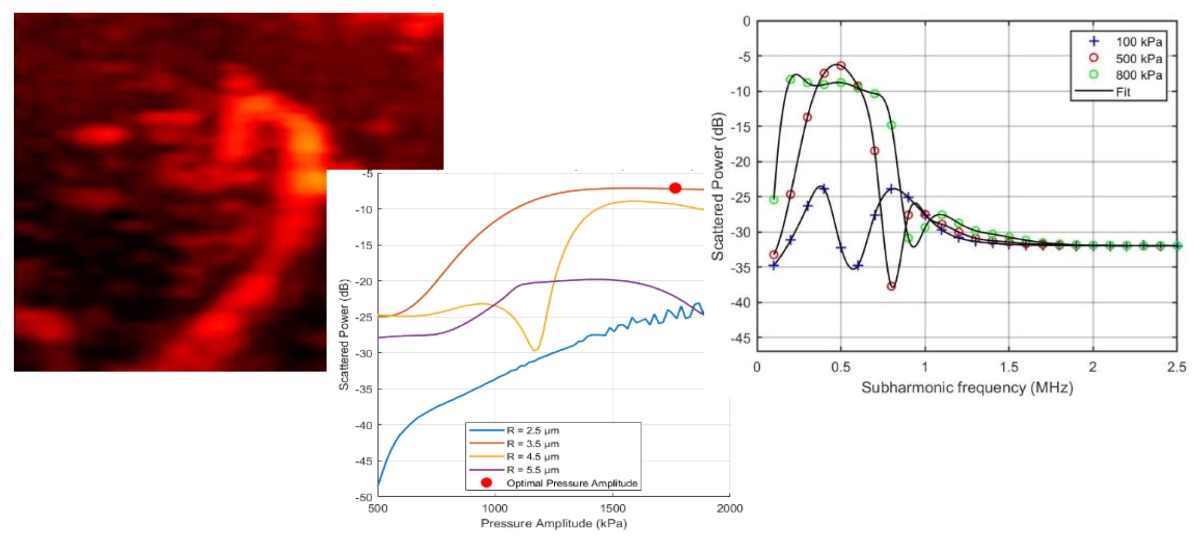
Coated microbubbles have become important ultrasound contrast agents because of their nonlinear oscillatory behavior, particularly their ability to generate subharmonic signals. These signals can improve the contrast-to-tissue ratio and enhance imaging quality through deeper penetration and lower attenuation. However, the strength of the subharmonic response is highly dependent on several parameters, including the initial bubble radius, excitation frequency, and acoustic pressure amplitude. Inappropriate parameter selection may reduce signal quality or even lead to microbubble destruction. In this study, a genetic algorithm was used as a metaheuristic optimization method to determine the optimal excitation conditions for maximizing subharmonic response intensity. The dynamic behavior of coated microbubbles was modeled using the modified Rayleigh-Plesset equation combined with the Marmottant shell model. The optimization objective was defined as the maximization of subharmonic scattering power by varying key parameters such as initial radius, excitation frequency, and pressure amplitude. The results showed that optimal performance was achieved for initial radii of 3 – 4 μm, excitation frequencies around 2 MHz, and pressure amplitudes between 1500 and 1800 kPa. Moreover, simultaneous multi-parameter optimization proved more efficient than single-parameter optimization, enabling more stable and effective operating conditions for enhanced ultrasound imaging. Unlike traditional studies that primarily focus on single-parameter sensitivity analysis, this research introduces a robust multi-parameter optimization framework. By leveraging genetic algorithms (GA), we address the intricate, nonlinear coupling between bubble radius, driving pressure, and excitation frequency. This approach moves beyond simple parameter sweeps to identify global optimal conditions for subharmonic response, offering a more comprehensive understanding of the acoustic-bubble interaction.
Graphical Abstract
Highlights
A genetic algorithm was employed to optimize the excitation and structural parameters of coated microbubbles for maximum subharmonic response.
The simultaneous effects of initial radius, excitation frequency, and acoustic pressure amplitude on scattered power were systematically investigated.
Microbubbles with an initial radius in the range of approximately 3 – 4 µm exhibited the strongest subharmonic scattering performance.
The optimal excitation conditions were identified around 2 MHz and 1500 – 1800 kPa, yielding the maximum subharmonic response.
[1]Paul, S. (2013). Acoustic characterization of ultrasound contrast microbubbles and echogenic liposomes: Applications to imaging and drug delivery. [Doctoral dissertation, University of Delaware]. http://udspace.udel.edu/handle/19716/20934
[2]Lee, H., Kim, H., Han, H., Lee, M., Lee, S., Yoo, H., Chanf, J. H., & Kim, H. (2017). Microbubbles Used for Contrast-Enhanced Ultrasound and Theragnosis: A Review of Principles to Applications. Biomedical Engineering Letters, 7(2), 59-69. https://doi.org/10.1007/s13534-017-0016-5
[3] Faez, T., Emmer, M., Kooiman, K., Versluis, M., van der Steen, A. F., & de Jong, N. (2013). 20 Years of Ultrasound Contrast Agent Modeling. IEEE Transactions on Ultrasonics, Ferroelectrics, and Frequency Control, 60(1), 7-20. https://doi.org/10.1109/TUFFC.2013.2533
[4]Aired, L., Doinikov, A. A., & Bouakaz, A. (2013). Effect of an Elastic Wall on the Dynamics of an Encapsulated Microbubble: A Simulation Study. Ultrasonics, 53(1), 23-28. https://doi.org/10.1016/j.ultras.2012.03.008
[5]Aired, L., Doinikov, A. A., & Bouakaz, A. (2012).Effect of an elastic wall on the behavior of encapsulated microbubbles [Paper presentation]. Acoustics 2012, Nantes, France. https://hal.science/hal-00811112v1
[6]Osei, E., & Al-Asady, A. (2020). A Review of Ultrasound-Mediated Microbubbles Technology for Cancer Therapy: A Vehicle for Chemotherapeutic Drug Delivery. Journal of Radiotherapy in Practice, 19(3), 291-298. https://doi.org/10.1017/S1460396919000633
[7]Flynn, H. G. (1975). Cavitation Dynamics. I. A Mathematical Formulation. The Journal of the Acoustical Society of America, 57(6), 1379-1396. https://doi.org/10.1121/1.380624
[8]De Jong, N., Hoff, L., Skotland, T., & Bom, N. (1992). Absorption and Scatter of Encapsulated Gas Filled Microspheres: Theoretical Considerations and Some Measurements. Ultrasonics, 30(2), 95-103. https://doi.org/10.1016/0041-624X(92)90041-J
[9]Church, C. C. (1995). The Effects of an Elastic Solid Surface Layer on the Radial Pulsations of Gas Bubbles. The Journal of the Acoustical Society of America, 97(3), 1510-1521. https://doi.org/10.1121/1.412091
[10]Hoff, L., Sontum, P. C., & Hovem, J. M. (2000). Oscillations of Polymeric Microbubbles: Effect of the Encapsulating Shell. The Journal of the Acoustical Society of America, 107(4), 2272-2280. https://doi.org/10.1121/1.428557
[11]Morgan, K. E., Allen, J. S., Dayton, P. A., Chomas, J. E., Klibaov, A., & Ferrara, K. W. (2000). Experimental and Theoretical Evaluation of Microbubble Behavior: Effect of Transmitted Phase and Bubble Size. IEEE Transactions on Ultrasonics, Ferroelectrics, and Frequency Control, 47(6), 1494-1509. https://doi.org/10.1109/58.883539
[13]Khismatullin, D. B., & Nadim, A. (2002). Radial Oscillations of Encapsulated Microbubbles in Viscoelastic Liquids. Physics of Fluids, 14(10), 3534-3557. https://doi.org/10.1063/1.1503353
[14]Allen, J., & Rashid, M. (2004). Dynamics of a Hyperelastic Gas-Filled Spherical Shell in a Viscous Fluid. Journal of Applied Mechanics, 71(2), 195-200. https://doi.org/10.1115/1.1653722
[15]Marmottant, P., Van Der Meer, S., Emmer, M., Versluis, M., De Jong, N., Hilgenfeldt, S., & Lohse, D. (2005). A Model For Large Amplitude Oscillations of Coated Bubbles Accounting for Buckling and Rupture. The Journal of the Acoustical Society of America, 118(6), 3499-3505. https://doi.org/10.1121/1.2109427
[16]Marmottant, P., Bouakaz, A., Jong, N. D., & Quilliet, C. (2011). Buckling Resistance of Solid Shell Bubbles under Ultrasound. The Journal of the Acoustical Society of America, 129(3), 1231-1239. https://doi.org/10.1121/1.3543943
[17]Sijl, J., Overvelde, M., Dollet, B., Garbin, V., De Jong, N., Lohse, D., & Versluis, M. (2011). “Compression-only” Behavior: A Second-Order Nonlinear Response Of Ultrasound Contrast Agent Microbubbles. The Journal of the Acoustical Society of America, 129(4), 1729-1739. https://doi.org/10.1121/1.3505116
[18]Katiyar, A., & Sarkar, K. (2011). Excitation Threshold For Subharmonic Generation From Contrast Microbubbles. The Journal of the Acoustical Society of America, 130(5), 3137-3147. https://doi.org/10.1121/1.3641455
[19]Hosseini, S. B., & Mahdi, M.. (2020). Numerical Investigation of the Radial Behavior and Scattered Pressure from the Encapsulated Microbubble in Vicinity of the Boundaries with Different Elasticities. Fluid Mechanics and Aerodynamics Journal, 8(2), 59-71. https://www.sid.ir/paper/370954/en
[20]Mahdi, M., Khalili, S., & Rahimi, M. (2021). A Modified Marmottant Model to Study The Effects of a Shell Rupture on the Subharmonic Threshold of Encapsulated Microbubbles. Journal of Particle Science and Technology, 7(1), 41-50. https://doi.org/10.22104/jpst.2022.5027.1186
[21]Barkand, A., & Mahdi, M. (2024). Numerical Investigation of the Effect of Lipid Shell Shedding Phenomenon of Ultrasound Contrast Agent Microbubbles on Their Frequency Response. Fluid Mechanics & Aerodynamics, 13(2), 67-79. https://dor.isc.ac/dor/20.1001.1.23223278.1403.13.2.6.4
[22]Gorce, J., Arditi, M., & Schneider, M. (2000). Influence of Bubble Size Distribution on the Echogenicity of Ultrasound Contrast Agents: A Study of SonoVue™. Investigative Radiology, 35(11), 661-671. https://doi.org/10.1097/00004424-200011000-00003
[23]Ivory, A. M., Meaney, J. F., Fagan, A. J., & Browne, J. E. (2020). Optimisation of the Transmit Beam Parameters for Generation of Subharmonic Signals in Native and Altered Populations of a Commercial Microbubble Contrast Agent SonoVue®. Physica Medica: European Journal of Medical Physics, 70, 176-183. https://doi.org/10.1016/j.ejmp.2020.01.017
[24]Spiekhout, S., Wang, Y., Segers, T., Kooiman, K., Versluis, M., Voorneveld, J., de Jong, N., & Bosch, J. G. (2025). Ambient Pressure Sensitivity of Subharmonic Vibrating Single Microbubbles. Ultrasound in Medicine & Biology, 51(6), 931-940. https://doi.org/10.1016/j.ultrasmedbio.2025.01.016
[25]Spiekhout, S., Voorneveld, J., de Jong, N., & Bosch, J. G. (2025). Dual-Frequency Subharmonic Ultrasound Contrast Imaging for Non-Invasive Blood Pressure Measurement. Ultrasound in Medicine & Biology, 51(5), 870-876. https://doi.org/10.1016/j.ultrasmedbio.2025.01.015
[26]Chen, S., Lu, C., Zhang, H., Yu, A. C., & Qin, P. (2026). Enhancing Subharmonic Response by Controlling Initial State of Monodisperse Microbubbles Via a Multi-Gas Core. Ultrasonics Sonochemistry, 132, 107954. https://doi.org/10.1016/j.ultsonch.2026.107954
[27] Van der Meer, S. M., Dollet, B., Voormolen, M. M., Chin, C. T., Bouakaz, A., de Jong, N., Versluis, M., & Lohse, D. (2007). Microbubble Spectroscopy of Ultrasound Contrast Agents. The Journal of the Acoustical Society of America, 121(1), 648-656. https://doi.org/10.1121/1.2390673
Mahdi, M. & Hosseini Amere, M. M. (2026). Optimization of coated microbubble parameters for maximum subharmonic response in ultrasound imaging. Journal of Particle Science and Technology, 12(1), 75–87. https://doi.org/10.22104/jpst.2026.8405.1296
MLA
Mahdi, M., & Hosseini Amere, M. M. "Optimization of coated microbubble parameters for maximum subharmonic response in ultrasound imaging", Journal of Particle Science and Technology, 12, 1, 2026, 75–87. doi: 10.22104/jpst.2026.8405.1296
HARVARD
Mahdi, M., & Hosseini Amere, M. M. (2026). 'Optimization of coated microbubble parameters for maximum subharmonic response in ultrasound imaging', Journal of Particle Science and Technology, 12(1), pp. 75–87. doi: 10.22104/jpst.2026.8405.1296
CHICAGO
Mahdi, M. & Hosseini Amere, M. M., "Optimization of coated microbubble parameters for maximum subharmonic response in ultrasound imaging." Journal of Particle Science and Technology, 12 1 (2026): 75–87, doi: 10.22104/jpst.2026.8405.1296
VANCOUVER
Mahdi M., Hosseini Amere M. M. Optimization of coated microbubble parameters for maximum subharmonic response in ultrasound imaging. JPST. 2026;12(1):75–87. doi: 10.22104/jpst.2026.8405.1296