Document Type : Research Article
Authors
1
Department of Biotechnology, Institute of Science and High Technology and Environmental Sciences, Graduate University of Advanced Technology, Kerman, Iran
2
Department of Agricultural Biotechnology, Payame Noor University, Tehran, Iran
Abstract
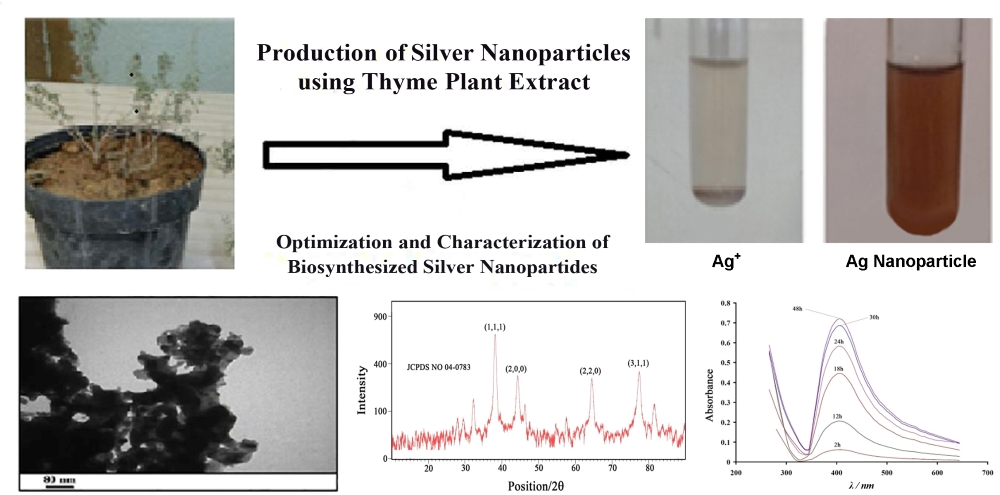
Nanotechnology is an attractive research field due to the production of nanoparticles in different sizes, shapes, chemical compositions, and distributions, and their many applications for humans. The fabrication, manipulation, and use of metallic nanoparticles are of great importance due to their reduced dimensions and, as a result, their unique thermal, optical, and electronic properties. Most nanoparticle synthesis techniques are inefficient considering material and energy consumption. In most chemical methods, dangerous chemical materials to humans and the environment are used. Accordingly, there is a demand for nanoparticle production using biological methods. Biological nanoparticle production methods have priority over physical and chemical methods considering energy cost, time reduction, and use of natural solvents. Currently, silver nanoparticles are one of the most commercial nanomaterials. In this research, silver nanoparticles were produced using thyme plant extract obtained using biological methods without any chemical materials. Various synthesis parameters such as temperature, pH, and synthesis time were optimized. The synthesized nanoparticles were characterized by various methods, including ultraviolet-visible spectroscopy (UV-Vis), transmission electron microscopy (TEM), X-ray diffraction (XRD), and zeta potential. The synthesized nanoparticles are spherical, with a mean diameter of 38.9 ± 10.4 nm (range 20–60 nm) as measured by TEM. Results show that biosynthesis of silver nanoparticles using thyme extract is a successful, cost-effective, and time-efficient method.
Graphical Abstract
Highlights
- The simple process of reducing metal ions and producing nanoparticles is carried out by primary and secondary metabolites such as antioxidants, flavonoids, flavones, isoflavones, anthocyanidins, isothiocyanates, carotenoids, and polyphenols.
- The production of silver nanoparticles by thyme extract was confirmed by spectrophotometric analysis, TEM, XRD, and EIS.
- The maximum silver nanoparticle production by thyme extract was achieved within 30 h at 35 °C and pH=10.
Keywords
Subjects