Journal of Particle Science and Technology

Journal of Particle Science and Technology

Device-Level Analysis and Optimization of a Novel YbZrSe3-Based Chalcogenide Perovskite Solar Cell: Thickness, Defect, and Band Alignment Optimization

Document Type : Research Article

Author
Department of Physics, University of Sistan and Baluchestan, Zahedan, Iran
10.22104/jpst.2026.8508.1301
Abstract
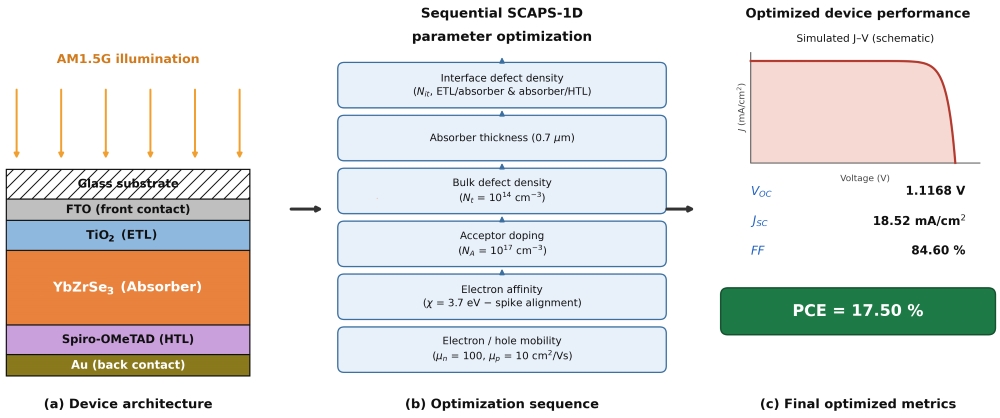
YbZrSe3 is an emerging lead-free chalcogenide absorber with a favorable bandgap for thin-film photovoltaics, but a systematic, device-level optimization of YbZrSe3-based solar cells has not previously been reported. Here, SCAPS-1D simulation is used to address this gap through a sequential optimization strategy, in which each device parameter was tuned in turn while holding the previously optimized parameters fixed. The influence of interface defect density at both the ETL/absorber and absorber/HTL junctions was first examined, revealing that the absorber/HTL interface is markedly more sensitive to defect-induced recombination, with degradation roughly three times larger than at the ETL/absorber interface. Subsequent optimization of absorber thickness (0.7 μm), bulk defect density (1014 cm-3), acceptor doping density (1017 cm-3), electron affinity (3.7 eV, corresponding to a favorable spike-like band alignment), and electron mobility (100 cm2/Vs) progressively improved device performance. The fully optimized device achieved a simulated power conversion efficiency of 17.50%, with an open-circuit voltage of 1.1168 V, a short-circuit current density of 18.52 mA/cm2, and a fill factor of 84.60%, compared with 14.05% for the unoptimized baseline. Recombination current analysis confirmed that interfacial recombination at the absorber/HTL junction dominates the total losses (over 97.5%) even after optimization, while quantum efficiency simulations showed a broad response exceeding 90% between 380 and 550 nm. These results provide the first systematic optimization framework and performance benchmark for YbZrSe3-based solar cells, identifying absorber/HTL passivation as the key route to further gains.
Keywords
Subjects


Articles in Press, Accepted Manuscript
Available Online from 09 September 2026

  • Receive Date 22 August 2026
  • Revise Date 06 September 2026
  • Accept Date 09 September 2026